Nepal Budget 2026: Key Impacts for Small Business Growth
Nepal's Budget 2026 introduces transformative policies that could reshape the small business landscape. Discover how new tax incentives, digital initiatives, and funding opportunities will drive entrepreneurial success.

Renuka Tamang
April 18, 2026
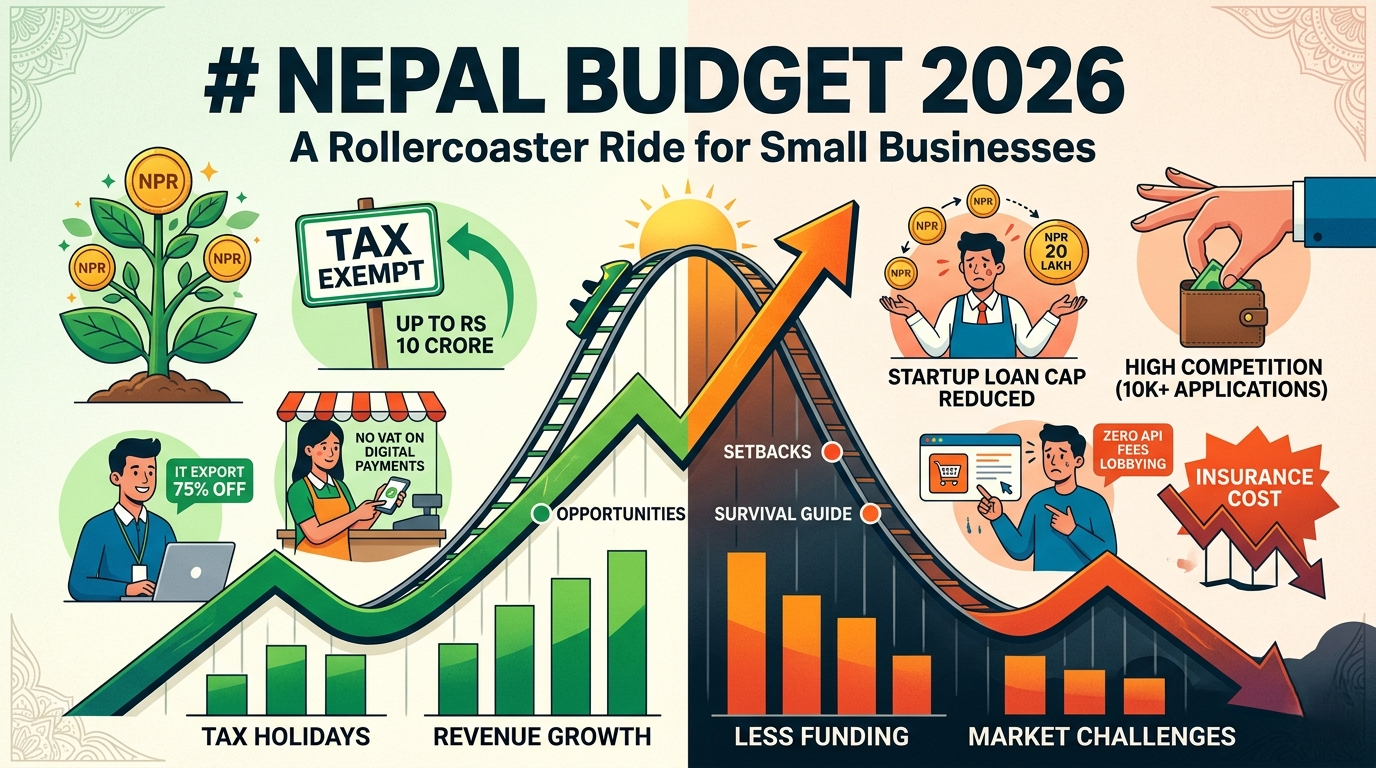
The fiscal year 2025/26 (2082 BS) has arrived with a budget that presents a paradox for Nepali small and medium enterprises (SMEs). On one hand, the government is slashing taxes and pushing for digitalization; on the other, it is tightening the purse strings on direct financial support.
If you are a small business owner, freelancer, or aspiring entrepreneur in Nepal, here is your ultimate guide to how the Budget 2026 will affect your wallet and operations, backed by the latest official data.
1. The Financial Reality: More Demand, Less Supply
The most immediate news for startups is the adjustment of the Subsidized Startup Loan.
While the government has kept the interest rate attractive at 3% per annum , the maximum loan limit has been reduced.
- The Cap Decreased: The maximum loan amount is now Rs 2 million (down from Rs 2.5 million) .
- Why? The Ministry of Industry cites "budget constraints," allocating Rs 730 million for the current fiscal year .
The Data Insight: The demand is explosive. The Industrial Enterprise Development Institute (IEDI) received a staggering 10,244 applications for these loans . With a target to serve only 400 entrepreneurs this year (down from 600 last year), the competition is fierce .
What this means for you: If you need heavy capital for manufacturing or hardware, you may need to look at alternative financing. However, for service-based or tech startups, the Rs 2 million cap, combined with the 3% interest, remains a golden ticket.
2. The Big Win: Tax Holidays and Exemptions
Despite the loan cap reduction, the budget offers massive tax relief that could significantly boost your cash flow.
The Rs 10 Crore Turnover Threshold
In a game-changing move, the government has expanded the definition of "Startup" for tax purposes. If your business has an annual turnover of up to Rs 100 million (10 Crore) , you are eligible for a 100% income tax exemption for the first five years . Previously, this limit was only Rs 1 crore.
Sector-Specific Good News
- IT and Exports: If you export IT services, you now enjoy a 75% tax exemption on export income, and individuals earning foreign currency while living in Nepal pay only 5% income tax .
- Tourism & Hospitality: Hotels and resorts have been granted the same privileges as "special industries," including income tax and electricity tariff exemptions .
The Digital Push (VAT Removed)
If you have been struggling to convince customers to go cashless, the government just helped you out. VAT on digital payments has been abolished . This makes electronic transactions cheaper for everyone, encouraging the shift away from cash.
3. The Operational Costs: Insurance and Interest
For those who secure government loans, there are new procedural updates regarding insurance.
The government has introduced the "Working Procedure on Grants for Concessional Loans, 2082."
- Insurance Coverage: For loans up to Rs 1.5 million, the government will cover 50% of the insurance premium. For loans above that, the borrower must bear the full cost .
- Subsidy Reduction: The government has reduced the interest subsidy component. While you pay 3%, the government is now providing a 3% grant to banks (down from 5% previously), signaling a gradual shift toward market discipline .
4. The Challenges: What Businesses Are Fighting Back Against
Not everything in the budget is smooth sailing. The Federation of Computer Association Nepal (CAN Federation) has raised red flags regarding the new Electronic Commerce Directives, 2082 .
The Grievances:
- API Costs: Startups struggle with high API integration fees from digital wallets like Khalti and eSewa. The CAN Federation is lobbying for "Zero API Fees" to allow small e-commerce portals to survive .
- Short Compliance Window: The directive originally gave businesses only 35 days to list on the new Department portal. The Federation has successfully proposed an extension to 90 days to prevent penalizing SMEs .
Advice: If you run an e-commerce site or social media store, keep a close eye on the amendments to these directives in the coming months.
5. Summary Table: Budget 2026 vs. Previous Year
| Feature | Budget 2025/26 (Current) | Previous Year (2024/25) | Impact on SME |
|---|---|---|---|
| Startup Loan Cap | Rs 20 Lakhs | Rs 25 Lakhs | Negative (Less capital) |
| Tax Exemption Turnover | Up to Rs 10 Crore | Up to Rs 1 Crore | Highly Positive |
| Interest Rate (Loan) | 3% (Subsidized) | 3% (Subsidized) | Neutral |
| Digital Payments | No VAT on fees | VAT Applicable | Positive |
| IT Export Tax | 75% Exemption | 50% Exemption | Positive |
Final Verdict: Should You Be Optimistic?
For the Bootstrapped Solopreneur: Yes. The tax exemptions are massive. You can now scale your business up to Rs 10 crore in revenue without paying corporate tax for five years. That is a huge retention of capital.
For the Capital-Intensive Startup: Proceed with caution. The reduction of the loan cap to Rs 20 lakhs is insufficient for manufacturing or deep-tech hardware. You may need to rely more on equity financing or angel investors.
For E-commerce/Digital: The removal of VAT on digital payments is a silent revolution, reducing transaction friction. However, wait for the final API cost directives to see your actual bottom line.
Disclaimer: This information is based on the budget announcements and initial procedures released in mid-2025 to early 2026. Entrepreneurs are advised to consult official Nepal Gazette notifications or a local chartered accountant for specific compliance.
Enjoyed this article?
Subscribe to get the latest posts delivered straight to your inbox.